
In the early years of football’s development, women’s participation in the sport was met with a mix of both enthusiasm and resistance. However, a significant setback occurred in 1921 when the Football Association imposed a ban on women’s football, prohibiting them from playing on FA-affiliated grounds. This decision stemmed from a combination of societal prejudice, fear of losing male spectators and concerns over the physical toll the sport might have on women. The FA argued that women’s football was unsuitable and inappropriate, a view that was widely held at the time.
The ban forced numerous women’s teams to disband, leaving countless talented athletes deprived of their passion. Nonetheless, this unjust prohibition failed to extinguish the love for the game amongst women and alternative leagues and competitions soon emerged, defying the FA’s restrictions. It was not until 1971, after five decades of inequality, that the FA finally lifted the ban. For their part, Liverpool were just as bad as other teams around the country in terms of the club’s treatment of the women’s game, but thankfully things have changed over the years and nowadays the Liverpool Women’s team is well-respected.
The History Of The Liverpool Women’s Team

When it comes to Liverpool Ladies, the history is a little more circumspect than you might imagine. Newton LFC was formed in 1989 by former England international Liz Deighan, before being renamed Knowsley United WFC two years later. The club became one of the founder members of the National Premier Division, which was organised by the Women’s Football Association.
Knowsley United made it to the final of the Premier League Cup in 1993, losing to Arsenal, but it was enough for a local Member of Parliament, Eddie O’Hara, to table an Early Day Motion congratulating the club on extending Merseyside’s appearance in Wembley finals.
A year later and the team made it to the final of the FA Women’s Cup, losing 1-0 to Doncaster Belles. It was a sign of how well the team was doing, even in spite of the lack of official support from the men’s team. That began to change in the mid-1990s, with an official link coming in 1994. At that point, the team took on the moniker of Liverpool Ladies Football Club. Whilst being attached to the men’s team was obviously good news for the advancement of women’s football on Merseyside, it would be untrue to suggest that it had an immediate impact on the club in terms of success.
The club lost in the final of the FA Women’s Cup in 1995, missing out 3-2 to Arsenal in a game played at Tranmere Rovers’ home ground of Prenton Park. They also lost in the final the following year, drawing 1-1 with Croydon in a match played at The Den before losing on penalties after extra-time. The team remained in the National Premier Division throughout much of the 1990s, but a chronic lack of investment meant that they later bounced between the top flight and the Northern Division. They won the Northern Division in 2003-04, returned to the top flight, but were relegated again the following season.
Under-Investment As The Standard
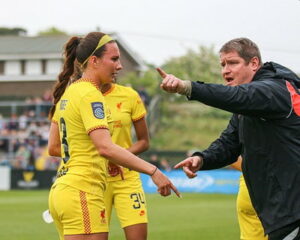
The reality of life at Liverpool Ladies was that the club wasn’t all that interested in investing into it in any meaningful way. This resulted in numerous seasons bouncing between the Premier League National Division and the Northern Division. When the Women’s Super League was formed in 2011, Liverpool were one of the founding members. This was in spite of the fact that the club had never really been viewed as a serious enterprise by the owners and, when Robbie Johnson stepped down as manager in June of 2012, he did so having won just two games in his final two seasons.
A decision was taken by the new manager, Matt Beard, to completely overhaul the squad when he came in in August of 2012. He released ten players and made some high-profile signings, bringing in United States international Whitney Engen, for example. Liverpool also became the first English club to offer every player in its women’s first team a full-time professional contract. It proved to be a wise move by Beard, who led the Reds to their first Women’s Super League title on the 29th of September 2013 when they defeated Bristol Academy 2-0 in an end-of-season title decider. That ended Arsenal’s run of nine consecutive English league titles.
The club retained the title the following season in dramatic circumstances, jumping from third to first on the final day after beating Bristol Academy 3-0. Beard left at the end of the 2015 campaign in order to take up a position as the Boston Breakers’ manager in the US. It had been a difficult season for Liverpool Ladies, with numerous injuries resulting in a seventh-placed finish in the WSL and no cup success. Scott Rogers was promoted from being Matt Beard’s assistant to taking full charge of the team. Even so, the underinvestment that had plagued the women’s team in the past continued, in spite of the fact that a landmark shirt sponsorship deal was signed with Avon Products in 2017.
A little over a year after that sponsorship deal had been signed, which resulted in Liverpool Ladies having their own sponsor separate from the men’s team, the club was re-branded to become Liverpool Football Club Women. In 2019, Standard Chartered took over as the front-of-shirt sponsor and Main Club Partner, bringing the commercial treatment of the women’s side more closely into line with that of the men’s team.
Relegation & Return

When the men’s team left Melwood and moved to their new training facility in Kirkby, Liverpool Women remained based at The Campus, Tranmere Rovers’ training facility on the Wirral. Melwood was eventually bought back and redeveloped for the women’s first team and academy, as will be discussed later.
When a decision was taken to curtail the 2019-2020 WSL season because of the global health crisis at the time, Liverpool Women were relegated into the FA Women’s Championship on a points-per-game basis. They remained there for two seasons, with Matt Beard eventually returning as manager in the summer of 2021.
With Beard back at the helm, Liverpool Women won the 2021–22 FA Women’s Championship after recording 16 victories from their 22 league matches. Jürgen Klopp, the manager of the men’s team at the time, summed up what had happened previously when he said, “Obviously, Liverpool was in the last years not famous for treating or dealing with women’s football outstandingly well. They didn’t go down to the Championship for no reason. Now they are back and we have to make sure that we use the situation. It is a wonderful team, great coach and I’m really happy for them to get promoted.”
Part of the move to re-invigorate the team’s chances involved the appointment of Russ Fraser as the Managing Director; the first to be appointed at Liverpool FC Women. It was, perhaps, a sign that the women’s team was being taken more seriously by the owners after years of both chronic underfunding and a lack of respect for the women’s side of the sport. Whilst that was largely in line with how a lot of football treated the women’s game, it was obviously disappointing for those involved in the Liverpool Women’s setup, as well as the supporters who watched the matches when they were on.
Back in the WSL, Liverpool finished seventh in 2022-23 before enjoying an excellent 2023-24 campaign and finishing fourth. The following season was more difficult. Beard left his post in February 2025, with Amber Whiteley taking interim charge and guiding the club to seventh place as well as the semi-finals of the Women’s FA Cup.
Gareth Taylor was appointed head coach in August 2025. His first campaign proved challenging and Liverpool finished 11th in the WSL in 2025-26, although they again reached the semi-finals of the Women’s FA Cup. Taylor remained in charge heading into the 2026-27 season.
There was sad news away from the pitch in September 2025 when Matt Beard died suddenly at the age of 47. Few people have had a bigger influence on Liverpool Women’s modern history: across two spells he won the back-to-back WSL titles in 2013 and 2014 and then returned to take the club back into the top flight in 2022.
Where They Play

Whilst you’d be forgiven for thinking that Liverpool FC Women would play all of their games at Anfield, the truth is that most women’s teams don’t play every match at the same ground as the men’s team. Liverpool were based at Prenton Park for many years, but that arrangement came to an end after the 2023-24 season.
From the start of the 2024-25 campaign, Liverpool Women moved to St Helens Stadium on a 10-year lease. The ground, which is also home to St Helens R.F.C., was given a new high-performance pitch and bespoke facilities for the women’s team. It is still in Merseyside rather than Liverpool itself, but it offers Liverpool Women a long-term home of their own rather than making use of Tranmere Rovers’ stadium.
Anfield is now used more regularly too. For the 2026-27 season, ten of Liverpool’s 13 Women’s Super League home matches are scheduled for St Helens Stadium, with the other three – against Everton, Arsenal and Aston Villa – being played at Anfield. Cup fixtures are generally staged at St Helens unless the club announces otherwise.
Where Liverpool Women Train

When the men’s team was based at Melwood, its training ground for most of the club’s existence, there wasn’t enough room there for the women’s team to be based there too. When a new state-of-the-art training facility was opened in the Kirkby area of the city, the women remained at The Campus, the home of Tranmere Rovers’ training facility on the Wirral. Melwood itself had been sold to housing development company Torus.
In 2023, Liverpool confirmed that they had decided to buy Melwood back from Torus. Local residents had disagreed with the sale in the first place, believing that it should be kept for the purpose of community outreach programs. In 2021, former Liverpool players Jamie Carragher and Robbie Fowler opened an academy at the site, which was aimed at helping young people to gain jobs in football alongside further education programs, whilst Liverpool looked into developing an elite training facility for the women’s team.
Word is that Liverpool are transforming Melwood into an elite training facility for their women’s first team & academy 👏
A club with a rich history of not giving a crap about their women’s side… could this indicate a shift? #BarclaysWSL
— The Women’s Soccer Show (@TheWOSOshow) June 11, 2023
That plan quickly became reality. Liverpool Women officially took up residence at Melwood in September 2023 and the site was opened as the AXA Melwood Training Centre later that month. It is now the permanent day-to-day base for the women’s first team and Professional Game Academy, giving them an elite facility in West Derby rather than having to train away from the city.
Andy Hughes, Liverpool’s Managing Director at the time of the repurchase, said, “Now is the right time to make this move and we’re absolutely delighted that we’ve managed to take this opportunity to return to Melwood and to see it start a new chapter of Liverpool’s commitment to our women’s first team and academy.”
How To Get Tickets

Tickets for Liverpool FC Women are now sold online, with home matches split between St Helens Stadium and Anfield. Match tickets are issued digitally and need to be downloaded to a supporter’s device before arriving at the ground. Ticket details are released through Liverpool’s women’s ticketing hub, with early-bird discounts available for supporters who book in advance.
For 2026-27, St Helens matches are split into Category A and Category B fixtures. Arsenal, Chelsea, Manchester City and Manchester United are treated as Category A opponents if they are played there, whilst the remaining St Helens league games are Category B. Adult match tickets range from £8 to £12 depending on the category and whether they are bought during the early-bird period, with cheaper prices for young adults, juniors and over-65s.
Liverpool also offer group discounts, with 10% off for groups of six or more and 15% off for groups of ten or more. Three league matches are being played at Anfield in 2026-27, against Everton, Arsenal and Aston Villa, and the club also sells a discounted Hat-Trick package covering all three games.
How Many Tickets Get Sold
| Date | Opposition | Attendance |
|---|---|---|
| 18/09/2022 | Chelsea | 3,006 |
| 25/09/2022 | Everton | 27,574* |
| 23/10/2022 | Arsenal | 3,348 |
| 06/11/2022 | Aston Villa | 1,719 |
| 04/12/2022 | West Ham United | 1,075 |
| 05/02/2023 | Reading | 1,608 |
| 12/02/2023 | Leicester City | 1,818 |
| 12/03/2023 | Tottenham Hotspur | 1,971 |
| 23/04/2023 | Brighton & Hove Albion | 1,888 |
| 07/05/2023 | Manchester City | 2,552 |
| 27/05/2023 | Manchester United | 5,778 |
*This match was played at Anfield
You would be forgiven for wondering how many tickets tend to be sold for Liverpool Women’s matches. There are numerous things that influence this, such as where the match is being played and who the opposition are. The table here looks at home league matches from the 2022-2023 season, giving you a useful historical snapshot from the period when Prenton Park was still the team’s regular home.
The difficulty is that attendance figures do not tell us which tickets were sold to away supporters, which supporters were season-ticket holders or how many tickets were bought as part of group sales. As a result, we can’t say with any sense of definitiveness how many individual match tickets were sold.
It is also important to remember that the setup has changed considerably since this table was compiled. Liverpool Women left Prenton Park in 2024, now play most home games at St Helens Stadium and stage three WSL fixtures at Anfield each season. The figures below are therefore best viewed as a snapshot of an earlier period rather than a guide to current demand.
Can You Get Season Tickets
| Category | Price |
|---|---|
| Adult | £70 |
| Young Adult (17-24) | £35 |
| Junior (16 and under) | £20 |
| Over 65 | £35 |
Whilst match-by-match tickets are generally widely available for Liverpool FC Women, regular supporters can also buy a season ticket and avoid having to purchase separately for every home game.
The table above shows the standard season-ticket prices for the 2026-27 campaign. An adult season ticket costs £70, whilst young adults aged 17 to 24 and supporters aged over 65 pay £35. Junior season tickets for those aged 16 and under cost £20.
The value has improved in terms of the number of matches included. With the Women’s Super League expanding, the 2026-27 season ticket covers 13 home league matches at St Helens and Anfield, three guaranteed home League Cup fixtures and any home Women’s FA Cup ties. Season-ticket sales for 2026-27 have now ended, but match-by-match tickets remain available during the campaign.
What Have They Won
| What They’ve Won | When They Won It |
|---|---|
| FA Women’s Premier League Northern Division | 2003-2004 |
| FA Women’s Premier League Northern Division | 2006-2007 |
| FA Women’s Premier League Northern Division | 2009-2010 |
| Keele Classic | 2010 |
| Women’s Super League | 2013 |
| Women’s Super League | 2014 |
| FA Club of the Year | 2014 |
| FA Women’s Championship | 2021-2022 |
Liverpool FC Women’s list of honours is not exactly the longest in the WSL, nor the women’s game in general, but there have been some significant successes over the years. Most notable are the back-to-back top-flight titles in 2013 and 2014, whilst the three Northern Division championships and the 2021-22 Women’s Championship title all resulted in promotion or a return to the highest level.
How They Stack Up Against The Men’s Team

As you can see from the table above, there isn’t a huge amount of comparison between the men’s team and the women’s. The men have now won the top-flight title 20 times, including the Premier League in 2024-25, to say nothing of six European Cups, eight FA Cups and a record 10 League Cups. Add to that the fact that Liverpool have won the UEFA Cup three times, the UEFA Super Cup four times and the FIFA Club World Cup once and it’s easy to see why the men’s side is one of the most successful in English football history, meaning that the women have got some way to go to catch up in terms of silverware.
That being said, the women’s team only officially became part of the football club in 1994. When you remember the extent to which women’s football was intentionally restricted by the Football Association for decades and then underfunded by many clubs, including Liverpool, it isn’t hard to understand why it is that the women still have some way to go before they are likely to be competing with the men in terms of the size of their honours list.
There has at least been significant investment in recent years, including the move to the AXA Melwood Training Centre and a long-term home at St Helens Stadium. The challenge now is to turn those improvements off the pitch into sustained success on it.
Who Have Been The Biggest Stars Up To Now

Having enjoyed success over the years, you might be interested to know who some of the biggest stars have been for Liverpool Women since the team became part of the wider Liverpool Football Club family. Here is a look at some of them:
Lucy Bronze
In men’s football, there aren’t many players who have moved directly from Everton to Liverpool. The same isn’t quite as true in the women’s game, as demonstrated by Lucy Bronze, who played for Everton between 2010 and 2012 before moving to Liverpool in 2013. She followed Natasha Dowie and Fara Williams in signing for the Reds, which happened when Liverpool became England’s first full-time women’s club. She was part of the team that won the WSL title in 2013 and then retained it a year later, helping the club to suffer only two defeats in 2013.
Natasha Dowie
It would be unfair to mention Lucy Bronze thanks to her part in Liverpool’s WSL winning side and not have a word for Natasha Dowie. Dowie began her playing career with Watford Ladies, signing for Fulham Ladies and then Charlton Athletic Ladies. When Charlton Scrapped their women’s team in 2007, she moved to Everton Ladies and then joined Liverpool in 2012. With 13 goals in 14 games, she finished the 2013 WSL season as the top goalscorer, being voted the FA Players’ Player of the Year. She was also instrumental in helping Liverpool Women win the title again the following year.
Fara Williams
Fara Williams was one of three women who left Everton to join Liverpool in the same summer, going on to become a crucial member of the team that not only won the title but also retained it. That came after eight years at Everton, including being the captain. Yet it was at Liverpool where she enjoyed the most success, thanks in no small part to those back-to-back WSL titles in 2013 and 2014. At the same time, she became England Ladies’ most capped player on the third of August 2014 when she played in the match against Sweden in Hartlepool, which England won 4-0.
Gemma Bonner
Given the fact that Liverpool FC Women’s biggest success came in 2013 and 2014 with those successive Women’s Super League titles, it is only right that we name the captain of the team as a ‘big star’. Gemma Bonner began her career with her hometown club of Leeds United, moving to Chelsea before signing for Liverpool in 2012 as part of Matt Beard’s overhaul of the club. Beard had worked with her at Chelsea and appointed her as captain, which was the role that she fulfilled when the club won those two league titles, lifting the trophy on both occasions before moving to Manchester City. She later returned to Liverpool in January 2023 and eventually left at the end of the 2025-26 campaign as the club’s all-time leading appearance-maker in the WSL era, having played 186 games across her two spells.


