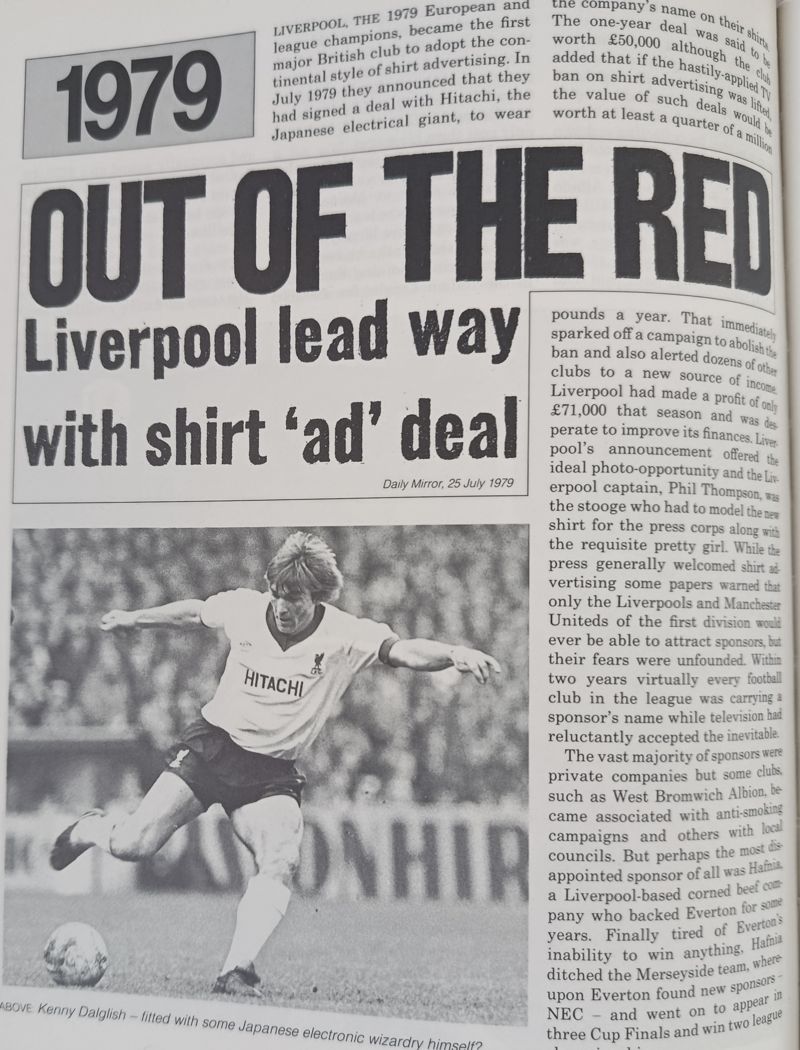
I was flicking through an old football book at the weekend when I landed on a page that surprised me. It was a Daily Mirror cutting from the July of 1979, crediting Liverpool with leading the way on putting a sponsor’s name across the front of their shirt. I had no idea that we got there first, considering the club’s reluctance to engage in flagrant capitalism at the time.
The full story is a bit more complicated than the headline, as these things usually are, but it was Liverpool’s deal with the Japanese electronics firm Hitachi that opened the door for the big clubs.
‘Fighting for Our Existence’
The Liverpool Chairman John Smith announced the one-year deal, worth £50,000, in the July of 1979. He made the decision not to dress things up, declaring, “We are fighting for our existence.” He explained to the press that the club had turned over about £2.4 million the year before and still made a profit of only £71,000. In his view, money through the turnstiles could no longer guarantee the future of the Reds, even though we were the most successful side in the country.
@the.fruit.boiler The first league team to wear a sponsor on their shirt. #Liverpool #Sponsor #LiverpoolFC #YNWA #Hitachi #Red #Reds #Anfield #JFT97 #Football #LFC #Liv #Scouse #Scousers #Kettering #KetteringTown #KetteringTyres #DerbyCounty #Derby #Saab #DCFC #KTFC #Footballkit #Footballstrip #Kit #Strips #Everton #Hafnia #EFC ♬ original sound – The Fruit Boiler
Club captain Phil Thompson was sent out to model the new shirt at Anfield alongside an actual model in the form of Teri Byrne. Hitachi already knew what a football shirt could do for a brand, as its name was on the Hamburg kit that was worn by Anfield old boy Kevin Keegan.
First, with an Asterisk

Liverpool weren’t the very first British club to try out a front-of-shirt sponsor. Southern League side Kettering Town wore the name of a local firm called Kettering Tyres on their shirts when they played Bath City in the January of 1976, continuing to do so until the Football Association stepped in. Derby County actually had a deal lined up with the auto manufacturer Saab in 1977, but the authorities blocked it. Meanwhile, in Scotland, Hibernian carried the name of kit maker Bukta from the start of the 1977-1978 campaign.
What Liverpool did was sign the first front-of-shirt sponsorship deal at an English top-flight club, doing so once the FA and the Football League finally gave in on the matter. Even then, Everton beat us onto the pitch. Our opening league game, against Bolton Wanderers, was on a Tuesday, three days after Everton wore their Hafnia shirts at home to Norwich City on the opening Saturday of the season. They lost 4-2 though, if anyone needs cheering up.
Hidden Whenever the Cameras Turned Up
Nowadays, talking about front-of-shirt sponsors and the sort of money involved all seems rather quaint, but it was serious stuff back in the 1970s. In fact, The BBC and ITV both refused to show matches in which players wore advertising, so the Hitachi name only appeared in games that were not on television, with cup ties also being off limits.
That rule around broadcasting wasn’t relaxed until the 1983-1984 season, by which time Crown Paints had replaced Hitachi. The shirt still saw plenty of silverware in its three seasons, as Liverpool won two league titles, a European Cup and two League Cups whilst wearing it.
From £50,000 to More Than £60 Million

Standard Chartered has been on the front of the shirt since 2010, whilst its current deal, which runs to the end of this season, is reported to be worth around £50 million a year. In the September of 2026, the club confirmed that Turkish Airlines will take over as our main sponsor from the June of 2027 on a five-year deal. The figures have not been officially published, but it’s reported that the deal is worth more than £60 million a season, which would put it amongst the richest shirt deals the Premier League has seen. Standard Chartered will stay on as a global partner, too.
Inflation barely makes any difference when comparing those early deals to the ones that the club enjoys in the modern era. Adjusted for rising prices, the Hitachi fee comes to roughly £330,000 in today’s money. The reported Turkish Airlines figure is around 180 times that in real terms, as well as being 1,200 times the original £50,000 in cash.
The share of the club’s income tells a not dissimilar story, too. Hitachi’s money was worth about 2% of Liverpool’s turnover back in the day, whilst Standard Chartered’s reported £50 million deal is about 7% of the £703 million that the club brought in during the title-winning 2024-2025 campaign, which was a year in which our commercial income alone came to £323 million.
Announcing the new deal, Chief Commercial Officer Ben Latty said the front of the shirt ‘holds a special place in the history of our club’. Smith wanted his Hitachi deal to show other clubs a new way to pay the bills and it did just that, but on a scale that he could never have imagined at the time.